

Morning Musically-Minded, Medically-Minded, Masticators!
(Today’s post is sponsored by the letter “M”)
Over the past 600+ episodes, The Simpsons has taken us on an amazing journey involving music, science, and food to name a few concepts.
And what better way to start your week, then by discussing some of these concepts Monday morning?


So let’s get started this week by talking about a modern pharmaceutical wonder drug from the fifteenth episode of our favourite family, Minoxidil.
In the fifteenth episode of The Simpsons, Simpson and Delilah (Season 02, Episode 02), after seeing an ad on TV, Homer tries a new hair growth formula called Dimoxinil. With the help of a shady doctor, he obtains the expensive product and wakes up with a full head of hair. With a new set of locks and a new found sense of confidence, Homer wins a promotion at work.


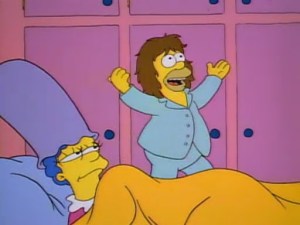

However, Homer’s hair and success prove to be short-lived when it is revealed that he fraudulently charged the Dimoxinil to the company health plan and Bart drops the last of Homer’s Dimoxinil supply. 

But while Dimoxinil may be a fictitious drug from the Simpsons, rearranging the letters gets you a wonder drug for male pattern baldness, Minoxidil (yes, I know Dimoxinil has an extra ‘i’; but I never said you couldn’t superimpose one ‘i’ on another ‘i’):
Minoxidil:
Minoxidil was originally developed in 1963 by pharmaceutical company Upjohn (now a part of Pfizer). As a powerful vasodilator (a drug that widens blood vessels), it was approved by the US FDA as an oral tablet for high blood pressure in 1979, sold under the brand name Loniten.
A pair of doctors (Dr. Guinter Kahn and Dr. Paul Grant) noticed that many bald patients using the drug for high blood pressure started developing significant hair growth. They started experimenting with topical Minoxidil doses as treatment for male pattern baldness. However, this resulted in a decade long legal battle for financial rights between Dr. Kahn and Dr. Grant versus Dr. Upjohn and Upjohn Pharmaceuticals.
While many doctors were prescribing Minoxidl as Loniten for off label use of male pattern baldness, it wasn’t until 1988 that the US FDA officially approved Minoxidil for male pattern baldness, at which point it was marketed as Rogaine. In 1991, Upjohn started selling the product for female consumers. On February 12th, 1996, the US FDA approved Minoxidil for over-the-counter sale and generic production for hair loss.
Minoxidil is available in numerous countries around the world. You may know it by one of these brand names: Alomax, Alopek, Alopexy, Alorexyl, Alostil, Aloxid, Aloxidil, Anagen, Apo-Gain, Axelan, Belohair, Boots Hair Loss Treatment, Botafex, Capillus, Carexidil, Coverit, Da Fei Xin, Dilaine, Dinaxcinco, Dinaxil, Ebersedin, Eminox, Folcare, Guayaten, Hair Grow, Hair-Treat, Hairgain, Hairgaine, Hairgrow, Hairway, Headway, Inoxi, Ivix, Keranique, Lacovin, Locemix, Loniten, Lonnoten, Lonolox, Lonoten, Loxon, M E Medic, Maev-Medic, Mandi, Manoxidil, Mantai, Men’s Rogaine, Minodil, Minodril, Minostyl, Minovital, Minox, Minoxi, Minoxidil, Minoxidilum, Minoximen, Minoxiten, Minscalp, Mintop, Modil, Morr, Moxidil, Neo-Pruristam, Neocapil, Neoxidil, Nherea, Noxidil, Oxofenil, Pilfud, Pilogro, Pilomin, Piloxidil, Recrea, Regain, Regaine, Regaxidil, Regro, Regroe, Regrou, Regrowth, Relive, Renobell Locion, Reten, Rexidil, Rogaine, Rogan, Si Bi Shen, Splendora, Superminox, Trefostil, Tricolocion, Tricoplus, Tricovivax, Tricoxane, Trugain, Tugain, Unipexil, Vaxdil, Vius, Womens Regaine, Xenogrow, Xue Rui, Ylox, or Zeldilon.
The mechanism by which Minoxidil promotes hair growth is not fully understood. Minoxidil is a potassium channel opener, causing hyperpolarization of cell membranes (a change in a cell’s membrane potential that makes it more negative). Theoretically, by widening blood vessels (vasodilation) and opening potassium channels, it allows more oxygen, blood, and nutrients to reach the hair follicles.
As hair follicles go through three stages of life – anagen phase with active hair growth, catagen phase as a short transition phase that signals the end of the anagen phase, and the telogen phase which is the resting phase during which shedding typically occurs. It is thought that Minoxidil may cause hair follicles in the telogen phase to shed quicker, which are then replaced by thicker hairs in a new anagen phase.
Pfizer notes that Minoxidil-induced hair loss is a common side effect and describes the process as “shedding”. Minoxidil is otherwise generally well tolerated, but common side effects include burning or irritation of the eye, itching, redness or irritation at the treated area, and unwanted hair growth on other parts of the body. Worsening of hair loss (alopecia) has also been reported.
Now that we’ve learned more about Minoxidil, be sure to come back next week when we continue our Monday morning musings with the next episode of The Simpsons.
Have you ever heard of Minoxidil? Do you know anyone who has used Rogaine or the generic Minoxidil? Did they experience Homer-like results? What’s your favourite Simpsons hair reference? What about your favourite Simpsons pharmaceutical-related episode? Sound off in the comments below. You know we love hearing from you.